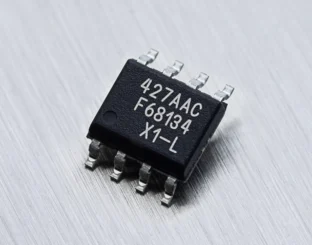
Texas Instruments (TI) has introduced the TMCS2100-Q1, a Hall-effect current sensor for traction inverters in hybrid and electric vehicles. The multi-axis sensor architecture reduces sensitivity to mechanical tolerances, vibrations, and magnetic crosstalk. The sensor simultaneously detects magnetic fields in both the horizontal and vertical directions and combines the measured values using a proprietary algorithm. According to TI, this enables the device to achieve up to 20 times greater accuracy than comparable coreless single-axis solutions.
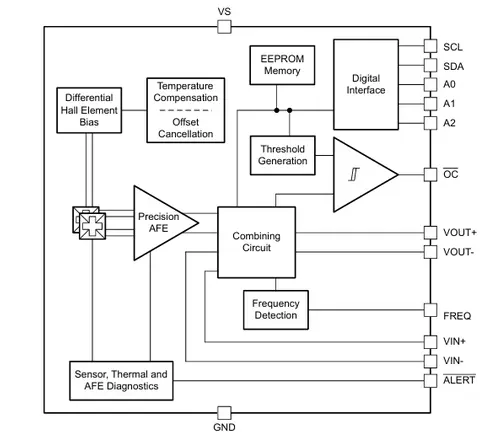
Block diagram of the Hall-effect current sensor. (© Texas Instruments)
According to the manufacturer, the displacement error is less than 1 percent for a movement of 0.4 mm and 0.25 percent for 0.1 mm. This is expected to improve current measurement, particularly for modern traction inverters with high requirements for efficiency and power density. The more precise current sensing also supports more accurate torque control, thereby improving the efficiency, driving performance, and range of electric vehicles. According to TI, the TMCS2100-Q1 is now available in production quantities upon request (oe)