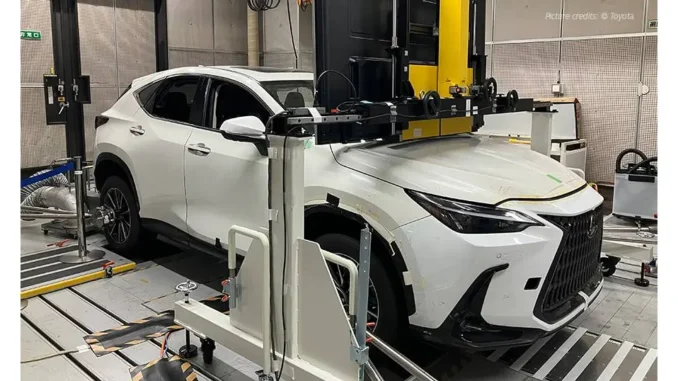
For the validation of driver assistance systems, Toyota relies on an end-to-end process that combines real measurements and virtual test environments using dSPACE tools. This results in precise and reproducible test scenarios that enable validation according to the SOTIF approach (ISO 21448).
The targeted generation of critical driving situations allows potentially unsafe scenarios to be identified at an early stage and systematically tested. In this way, the developers were able to identify weak points and minimize risks for other road users.
The report describes how traffic data was recorded with the dSPACE tool AUTERA on the basis of extensive measurement runs, then processed with the help of AI and transferred into simulatable scenarios with the Traffic Virtualizer. These can be used to accurately depict real-life situations as well as in a varied form to specifically investigate corner cases. The scenarios generated in this way are used in the ADAS Real Car Simulator, which couples real vehicles with virtual environments. This allows critical traffic situations to be tested without risk and systems to be validated under difficult conditions.
Daiki Miyata, who works at Toyota Motor Corporation in the vehicle technology development department and the innovation department for XILS development, explains in the article how real traffic flows were precisely recorded, road details and vehicles were annotated using understand.ai tools and logical scenarios were created from the data. OpenX standards such as OpenDRIVE and OpenSCENARIO were used for seamless integration into the virtual test environment.
Toyota plans to further expand the simulation environments in order to depict complex traffic situations even more realistically and accelerate the safe introduction of automated driving systems. (oe)