
In developing AI-based driver assistance systems, Bosch relies on its own optimization toolchain to tailor neural networks specifically to the target hardware. As the company explains in an interview with Markt&Technik, the focus is not on developing new neural networks, but rather on their efficient implementation on automotive SoCs. Bosch explains how its proprietary AI optimization toolchain tailors models to the target platform through hardware-aware transformations, quantization, and benchmarking. Key factors here include not only latency and computing power, but also perception quality, determinism, and real-time capability. In the interview, Texas Instruments complements this perspective with details on the new TDA5 SoC family and the C7 NPU. In addition to high energy efficiency and scalable AI computing power, the focus is particularly on the heterogeneous architecture and integrated security features. Also of interest is the close collaboration between the two companies in optimizing transformer-based models such as BEVFormer, as well as the use of a Virtualizer Development Kit that enables software development and validation even before the hardware is available. (oe)
News
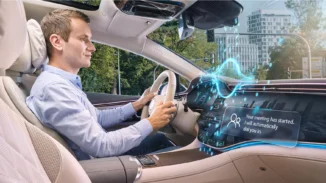
CES: Bosch zeigt KI-Plattform für intelligente Fahrzeugcockpits
KI-Hochleistungsrechner auf Basis von NVIDIA DRIVE AGX Orin ermöglicht der intelligente Cockpit-Funktionen und skalierbare KI-Integration für softwaredefinierte Fahrzeuge.

Branchen-News
Valeo: smart mit Valeo-ADAS erreicht 5-Sterne im Euro NCAP-Crashtest
Der smart #3 erreichte mit Valeo-ADAS eine 5-Sterne-Bewertung bei den Ende 2023 veröffentlichten Crashtests von Euro NCAP.
Branchen-News
BMW und Alibaba bringen Sprachmodell Qwen-KI in die Neue Klasse
Kernstück ist eine angepasste Version von Alibabas großem Sprachmodell Qwen, das über Banmas KI-Lösung Yan AI vollständig in das BMW-Bediensystem eingebunden wird.