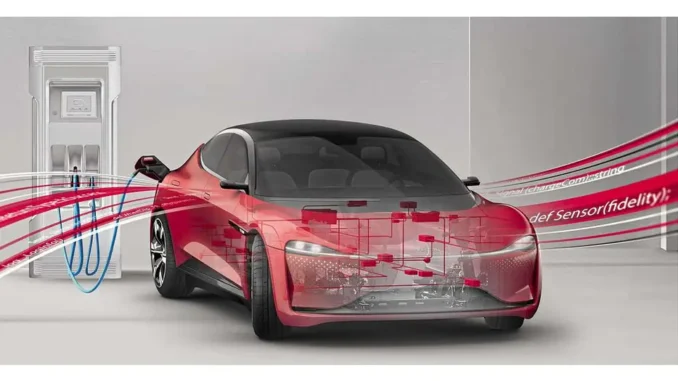
How can the growing complexity of charging communication in software-defined vehicles be managed? Tobias Schneider and Michael Vick of Vector Informatik explore this question in a recent technical article in Elektronik Praxis. In it, they present an architectural concept that demonstrates how efficiency, safety, and performance can be better balanced in modern vehicle platforms.
At its core, this article analyzes the role of the Electric Vehicle Communication Controller (EVCC) within new, zone-based E/E architectures. With the transition to the software-defined vehicle, requirements are increasing significantly: functional safety, cybersecurity, and short response times must all be met simultaneously, while vehicle architecture is increasingly shifting toward centralized high-performance computers.
The authors first compare three possible integration approaches for the EVCC: as part of the onboard charger, integrated into a zone control unit, or as a distributed solution. The focus below is on a distributed approach, which is considered particularly future-proof.
In this architecture, tasks are specifically allocated. Time-critical and security-related functions remain on a microcontroller within a gateway, while computationally intensive processes such as encryption, certificate management, and protocol processing are offloaded to a high-performance computer. This separation offers clear advantages: It not only enables better utilization of the respective hardware capabilities but also faster execution of security-related communication processes. At the same time, the initial steps of charging communication can begin even before the entire system has fully booted up.
Measurements from the project show that the duration of cryptographic processes, in particular, can be significantly reduced. For example, the TLS handshake is shortened by a factor of several times, which has a direct positive impact on loading times.
However, as the authors point out at the end, this approach also has consequences: Distributing the system across multiple control units increases system complexity and, consequently, the effort required for integration, testing, and validation. More communication interfaces and different software platforms must interact reliably. Issues such as updates and variant management also become more challenging, but at the same time offer new opportunities through centralized software services.
Overall, the article makes it clear that a distributed architecture is a sensible approach to meeting the growing demands on charging communication in software-defined vehicles.(oe)
Link to the Artikel (pdf, 3 Seiten)