48-volt systems are gaining importance in vehicles because, as electrical power increases, issues such as current, cable cross-sections, weight, and costs come into play. At the same time, OEMs are taking different approaches to implementation. What role will 48-volt systems actually play in next-generation vehicle architectures? And will this develop into a market with lasting relevance—or will 48-volt systems ultimately remain a temporary solution? In this interview, Karsten Müller, Director of Product Management at TE Connectivity, and Dr. Hendrik Kolbe, Product Manager at TE Connectivity, answer these questions and explain the strategies automakers are currently pursuing.
AEEmobility: Let’s start by looking at market trends: How has the market for 48-volt connectors evolved in recent years, and which vehicle segments do you believe are the primary drivers of this growth?

Karsten Müller: The industry is currently facing increasing cost pressures, due in part to rising raw material prices. At the same time, the issue of reducing vehicle weight is regaining importance. While the primary focus for conventional vehicles is on reducing CO₂ emissions, the main goal for electric vehicles is to achieve a longer range. Vehicle weight has thus once again become an important development factor, after having lost some of its significance in recent years compared to other trends.
The most important driver for 48-volt systems is the increasing electrical power consumption of modern vehicles. If high-power loads continue to be supplied with low voltage, the currents will increase—and with them, cable cross-sections, weight, and costs. However, it remains to be seen which electrical system solution will prevail: Some electric vehicle manufacturers want to avoid an additional 48-volt level as much as possible and supply high-power consumers directly from the high-voltage system. This requires, for example, zonal subsystems or locally integrated voltage converters. In vehicles with internal combustion engines, on the other hand, larger wire cross-sections may suffice, or an additional 48-volt level may be appropriate. In addition, there are initiatives to completely replace the 12-volt electrical system with 48 volts in the long term. At present, however, factors such as the availability and scalability of suitable electronic components argue against a rapid transition. Consequently, different architectures are emerging with two or three voltage levels, such as 12, 48, and high voltage. It is therefore currently difficult to clearly assign these architectures to specific vehicle segments or powertrain types. Rather, the decisive factors are the respective vehicle architecture, the power requirements, and the manufacturers’ strategic direction.

Hendrik Kolbe: In my view, there isn’t a single solution along the lines of: “We’re switching to 48 volts now, and that solves all our problems.” Rather, 48 volts is an additional tool that allows us to respond to the challenges posed by the increasing electrical power in the vehicle. And as more and more functions are added—and redundancies sometimes become necessary—the power demand continues to rise. So the real question is: How do I implement 48 volts? Do I start by specifically targeting the components with the highest power consumption and switching them to 48 volts to reduce the current level there? Or do I integrate 48 volts directly into a new vehicle architecture—for example, in conjunction with a zonal architecture—and route the power accordingly to the zonal distributors?
These are very different approaches. And that naturally raises the question: Should I completely rethink the architecture and redefine the interfaces as well? Or can I start by working with existing solutions that are already suitable for 48 volts or voltages up to 60 volts, for example? That’s why, in my view, there isn’t just one strategy. Each manufacturer must decide for itself what works best: What is the fastest solution, what is the simplest, what makes economic sense, or where do I want to take a major architectural leap right away?
Do you see any regional differences in this trend? For example, do Chinese manufacturers operate differently from European ones?
Karsten Müller: I wouldn’t make such a strong distinction by region anymore. In the past, the automotive market was very clearly divided into Asia, Europe, and the Americas. Today, I’d say the market is segmented based on the pace of change: We have manufacturers with a long history and established organizational structures. For these companies, it’s naturally more difficult to quickly implement disruptive changes like 48-volt systems because existing processes, architectures, and supply chains must be taken into account. But then there are also manufacturers that have a long history as well, yet manage to align their existing organization relatively consistently with a central technological vision. They can drive change forward more quickly as a result. And on the other hand, we have the so-called greenfield providers. They have significantly fewer established structures and can therefore operate with very short innovation cycles. They simply don’t carry the “burden of legacy” to the same extent. That’s why I would be less inclined to say today: “China does things differently than Europe.” I would rather say: What matters is how quickly a company can adapt its organization, its vehicle architecture, and ultimately its supply chain to new technological requirements.
Although 48 to 60 volts are still below the high-voltage threshold, they place greater demands on connectors. Can you draw on your existing product portfolio for this, or will new developments be necessary?
Karsten Müller: I would actually distinguish between two issues here. The first concerns potential connector mating operations while the system is energized or under load, which—from a reliability perspective—are managed as a system-level issue through appropriate measures. The second is the question of what requirements for a connector are relevant and appropriate for use with 48V systems.
Hendrik already touched on this briefly: There isn’t just one solution here. For example, we’re talking to vehicle manufacturers who say: We have a large portfolio of connectors that has proven itself over decades. Can’t we simply use these existing connectors for 48 or even 60 volts as well? And in fact, many of our existing connectors are fundamentally capable of doing so. This means you don’t necessarily have to develop a completely new connector portfolio for 48 volts. In many cases, existing 12-volt connectors can be scaled up accordingly. The key question then is: What specific requirements does the respective application place on the connector, and at what point do I actually need new design solutions?
Hendrik Kolbe:I think that’s exactly the point when it comes to the requirements for 48 volts. I would first distinguish between the minimum requirements and the additional requirements specified by the respective vehicle manufacturer. The minimum requirements, for example, concern the well-known clearances and creepage distances specified in IEC 60664-1. For us as a connector manufacturer, these are fundamental design criteria. If these distances are maintained—for example, in single-conductor-sealed systems—such a connector system can, in principle, also be used for 48 volts or up to 60 volts.
In addition, the automaker may, of course, impose additional requirements. These could include, for example, specific color coding, an additional locking mechanism, or other specific requirements for the connector system. However, if we first consider only the clearances and creepage distances relevant to the design, we find that many existing connector systems do not need to be fundamentally redesigned or scaled for 48 to 60 volts. Due to their existing design, they can already be used in this voltage range.
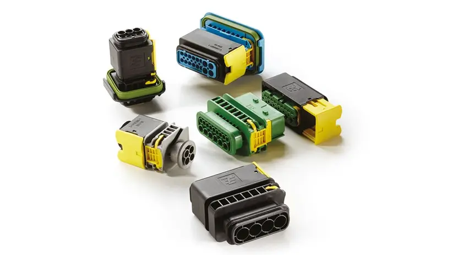
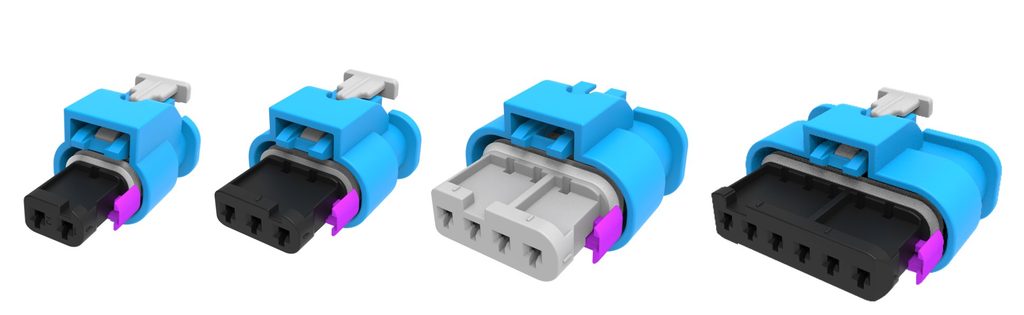
Heavy-duty, sealed 48-volt connectors for demanding operating conditions. (© TE Connectivity)
What are the requirements for the thermal design? For example, can the existing 12-volt connectors still be used for this purpose?
Hendrik Kolbe: For a given power rating, the required current initially decreases when switching from 12 to 48 volts. For connectors, this means that there is no general requirement to transmit higher currents at 48 volts. Rather, the thermal limit of the respective contact system is the determining factor. An existing connector solution—one designed, for example, to handle a maximum current of 15 amps at 12 volts—can transmit significantly more electrical power at 48 volts. In this respect, it cannot be said across the board that 48-volt applications always require new connectors. Things get interesting when it comes to the additional requirements that customers place on higher voltage levels. These vary widely. For example, there is a desire for a sealed chamber extending all the way to the rear of the connector, particularly for contacts that carry higher currents. In many cases, such requirements can also be met by adapting existing connector systems. However, it is important to distinguish between safety and robustness. Not every additional requirement is automatically a safety requirement. One example is the sealing of individual chambers. The fact that a system operates at 48 volts does not necessarily mean that it must be completely sealed.
First, the minimum technical requirements must be considered, such as clearances and creepage distances. Next, the specific installation situation must be analyzed: What types of contamination might occur? What failure scenarios are realistic? And what effects do moisture or other media have on the system? While higher voltages can accelerate certain physical or chemical processes, this does not mean that switching from 12 to 48 volts automatically gives rise to numerous new critical failure phenomena. What is far more decisive is the specific application and the question of which requirements are actually technically necessary. This is precisely the discussion we are currently having with market participants. While 48 volts is already familiar from mild-hybrid applications, it is used there in a comparatively specific field of application. The challenge now is to apply this voltage level to a much broader range of applications.
And what about the installation space?
Hendrik Kolbe: I don’t really see installation space as a major issue in this context. I would view 48 volts more as an additional solution in the toolbox. If I have applications where I currently need large contacts and correspondingly large connectors, switching to 48 volts—while maintaining the same or a similar power class—allows me to design a smaller system. This can even lead to optimized installation space and greater integration. This also becomes interesting when it comes to mating forces. If I currently have a large connector on a high-power unit, I may already need to consider using a lever or some other support. If I can reduce the currents—and thus the required contact cross-sections—by switching to 48 volts, it may be possible to combine two connectors into a single integrated solution—even without an additional lever. This ultimately allows me to design the system to be more compact not only electrically but also mechanically.
And what about mixed voltage levels—that is, when 12-volt and 48-volt systems coexist in a single connector?
Hendrik Kolbe: That’s actually an interesting point and is currently being discussed: Can and should two voltage levels be integrated into a single connector? Technically, this is possible in principle. But then we’re back to the minimum requirements, such as air and creepage distances. There are also detailed considerations, for example regarding ground connections. If 12- and 48-volt systems have partially separate grounds, one must consider whether certain distances must be maintained or whether additional measures against interference are necessary. Ultimately, this depends on the specific design. From a PFMEA perspective, the question also arises as to which contacts should be deliberately separated from one another and which can be combined. But it’s important to note: Just because 12 and 48 volts coexist in the same vehicle electrical system doesn’t automatically mean that different connectors are required. Integrating both voltage levels into a single connector system is certainly technically feasible.
Do you see potential for greater standardization of connectors?
Karsten Müller: When we look at the changes in vehicle architectures and the different voltage levels, the question naturally arises: What will the connector portfolio for the next generation of vehicles look like? Can we talk more about standardization here? Or at least about specific connector types and interfaces that can be used for different types of powertrains? “Standardization” is, of course, a big word in the automotive industry. But we can at least consider the design and modularization of interfaces. This is precisely the direction of the discussions we’re currently having with some OEMs: How can interfaces be made more general-purpose and modular in the future so that they can be used across different applications and powertrains?
TE Connectivity designs its 48-volt connectors to meet the required clearances and creepage distances. In doing so, the company takes into account factors such as pollution degree, material group, rated voltage, and mounting height. Many existing connector systems with individual wire seals already meet the requirements by design, as the seal creates additional spacing between the contacts.
TE Connectivity also uses its own calculation tool for the design process. If the existing clearances are insufficient in certain applications, selective populating of the contact chambers can be used, for example, to increase the required clearances between the contacts. This allows existing connector solutions to be specifically adapted to higher voltage levels without necessarily having to develop a completely new design.
How do you assess the long-term prospects for 48 volts? Do you expect this voltage level to become established permanently, or do you see 48 volts more as a transitional solution on the path to a higher-voltage architecture?
Karsten Müller: I don’t believe that a significantly higher low-voltage level will become the norm in the long term. In my view, 48 volts strikes a balance between the required power and the voltage class, especially with regard to safety requirements. At the same time, I think it makes sense to establish a 48-volt system alongside the established 12-volt system. I therefore consider another, even higher low-voltage system to be rather unlikely. Whether 48 volts will actually become established in the long term, however, remains to be seen. That depends, among other things, on how cost-effectively smaller electrical components in electric vehicles can be connected directly to the high-voltage system in the future. If high-performance and affordable power electronics become available for this purpose, the importance of an additional 48-volt level could diminish again. On the other hand, the question arises as to how quickly the transition from 12 to 48 volts will actually take place. My assessment, therefore, would be that both 12 volts and 48 volts will remain relevant in parallel for the foreseeable future.
Hendrik Kolbe: In my view, 48 volts is already very close to the sweet spot for efficient and cost-effective power distribution in the low-voltage range. If you consider the 60-volt threshold, there is very little leeway above that point before significantly more complex and costly solutions become necessary. With 48 volts and the permissible voltage spikes, we are already operating close to that threshold. A even higher low-voltage level therefore seems to make little sense. However, 12 and 48 volts will definitely coexist. After all, 48 volts is not being introduced simply to create a new voltage level, but to solve specific technical problems, particularly those involving higher power requirements. For this reason, there will not be a complete and rapid transition from 12 to 48 volts. Rather, applications will be switched to 48 volts on a targeted basis where it makes technical and economic sense, while existing 12-volt applications will continue to operate.
In your view, is the current bottleneck in the adoption of 48-volt systems still primarily with semiconductor and power electronics manufacturers?
Karsten Müller: I would view this more as a classic chicken-and-egg situation. If the automotive industry makes a clear commitment that 48 volts will play a greater role in certain applications and powertrains in the future, the power electronics industry will follow suit. That’s because the necessary production volumes—and thus the economies of scale—will then be foreseeable. Conversely, however, the same applies: If semiconductor and power electronics manufacturers offer appropriate solutions in larger volumes at an early stage—thereby creating the technical and economic conditions—the automotive industry will respond accordingly. That’s why I wouldn’t say that the bottleneck clearly lies on one side or the other. Rather, it’s an iterative process in which both sides influence each other. Ultimately, the decisive factor is when sufficient volume is achieved to enable the corresponding economies of scale in power electronics.
Given this context, how do you estimate the market potential for 48-volt systems and related components?
Karsten Müller: Of course, the first question that comes to mind is what exactly should be included in this market. Are we talking solely about connectivity, or do we also include, for example, cables and other components? Above all, there’s also the time factor to consider. We’re all on this journey together right now. That’s why I’m not at all interested in citing a specific market figure here. What’s crucial, rather, is that the current scenarios vary widely.
Every vehicle manufacturer, as well as the various market participants, is currently in different stages of development. It is not yet clear how long the transition and overlap phase between the different voltage levels will last, or whether a unified architecture will ultimately prevail at all. Therefore, a great deal remains uncertain at this time, both in terms of the long-term architecture and the duration of the transition phase. One thing is clear, however: we are talking about a significant proportion of connectors in the power sector. If a large portion of these applications switches to 48 volts, this will create a significant market. If, on the other hand, certain developments overlap or applications switch directly to other voltage levels, the potential will be correspondingly smaller. The range of possible market scenarios is therefore still very broad at this time.
Thank you very much for the interview!
The interview was conducted by Klaus Oertel, publisher and editor-in-chief of AEEmobility