Augmented reality head-up displays (AR-HUDs) are evolving from a premium feature to a central display element in smart cockpits. However, high brightness, precise color reproduction, and compact designs pose significant challenges for developers. In this interview, Martin Unterburger, Director of Product Management at ams OSRAM, explains the role that RGB projection LEDs play in the next generation of head-up displays and the importance of optics, thermal management, and OEM partnerships in this context.
AEEmobility: Mr. Unterburger, why are AR head-up displays currently taking center stage in automotive development?
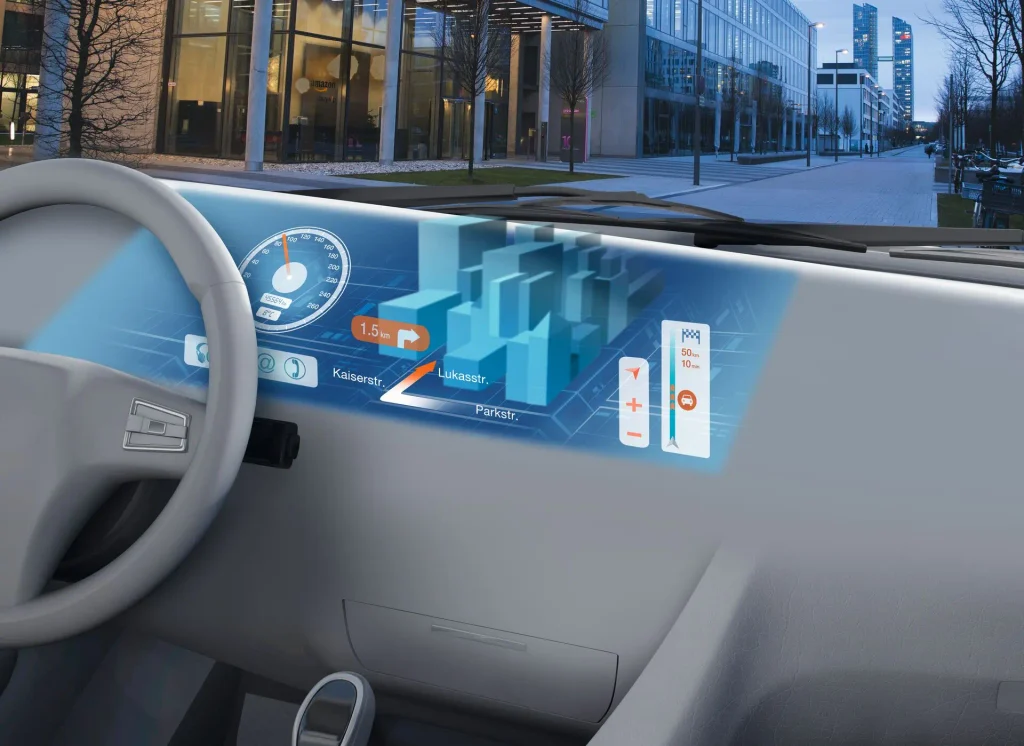
Martin Unterburger: Customer expectations have changed significantly. Today, drivers expect navigation instructions, driver assistance information, and warning messages to appear directly in their field of view without having to take their eyes off the road. At the same time, this technology is increasingly making its way from luxury vehicles into mid-range models. This is increasing the pressure to develop AR-HUDs that are more compact, cost-effective, and, at the same time, more powerful. The real challenge lies in combining high image quality, reliability, and automotive suitability within a very limited installation space.
What technical challenges are developers facing the most today?
There are several closely interrelated challenges. The available installation space behind the dashboard is becoming increasingly limited, while at the same time there is a demand for larger fields of view and brighter projections. Added to this are high requirements for readability in direct sunlight, consistent color reproduction under all environmental conditions, and precise alignment of virtual content with the real environment. In augmented reality in particular, color, brightness, and geometric stability must remain constant across temperature variations, vibrations, and the entire service life. Issues such as thermal management, functional safety, and electromagnetic compatibility also play a crucial role.
You also mention the importance of the light source. Why is it so crucial?
The light source influences far more than just brightness. Ultimately, it determines the entire system architecture of a projection HUD. A key concept here is optical étendue—that is, the measure of how widely a light beam spreads out spatially and in terms of its angular distribution. If the light source is not optimally matched to the projection optics—for example, to DMD or LCoS imaging systems—a significant portion of the light output is lost. The consequences would be larger optics, higher energy consumption, and increased heat generation. That is why we develop our projection LEDs specifically to meet the requirements of these projection systems.
Why do you rely on RGB projection LEDs rather than exclusively on laser or LCD solutions?
RGB projection LEDs offer a very balanced technical approach. Unlike LCD systems, which suffer from backlight leakage due to their design, LEDs—when combined with DMD or LCoS projectors—produce images with very high contrast. This significantly improves the sharpness of warning symbols, navigation prompts, and AR overlays. At the same time, LED systems avoid some of the typical drawbacks of coherent laser solutions, such as speckle effects or additional photobiological safety requirements. This provides developers with a high-performance, robust, and comparatively easy-to-integrate light source for production vehicles.
„The light source alone does not make a head-up display. Only close collaboration between LED manufacturers, optics developers, Tier 1 suppliers, and OEMs enables a perfectly coordinated overall system.“
Martin Unterburger, Director Produktmanagement at ams OSRAM
A key issue is readability in daylight. What performance data is required for this?
Daylight is indeed the most challenging application. Our OSTAR Projection Compact RGB LEDs are based on chip technology with current densities of up to 4.0 A/mm² for the green and blue variants. This allows for exceptionally high light output to be generated from very small optochips. For AR-HUDs, we achieve luminance levels of up to 15,000 cd/m² with a field of view of 20 × 8 degrees. This ensures that information remains clearly visible even in direct sunlight or when there are strong reflections inside the vehicle. What matters here is not just absolute brightness, but the combination of brightness and contrast. Only this ensures that virtual content remains reliably readable under real-world driving conditions.
What role does color accuracy play in driver assistance systems?
A very large one. Colors convey specific information inside a vehicle—for example, red indicates warnings, while green signifies navigation or clearances. That is why these colors must be rendered consistently, regardless of temperature, aging, or ambient light. Our RGB projection LEDs operate with three color channels: Amber (red), Converted Green (green), and Blue (blue). This multi-channel architecture enables precise color mixing while expanding the reproducible color gamut. This gives developers significantly more creative freedom when designing user interfaces and AR icons. For safety-critical displays, this reproducibility is a key quality factor.
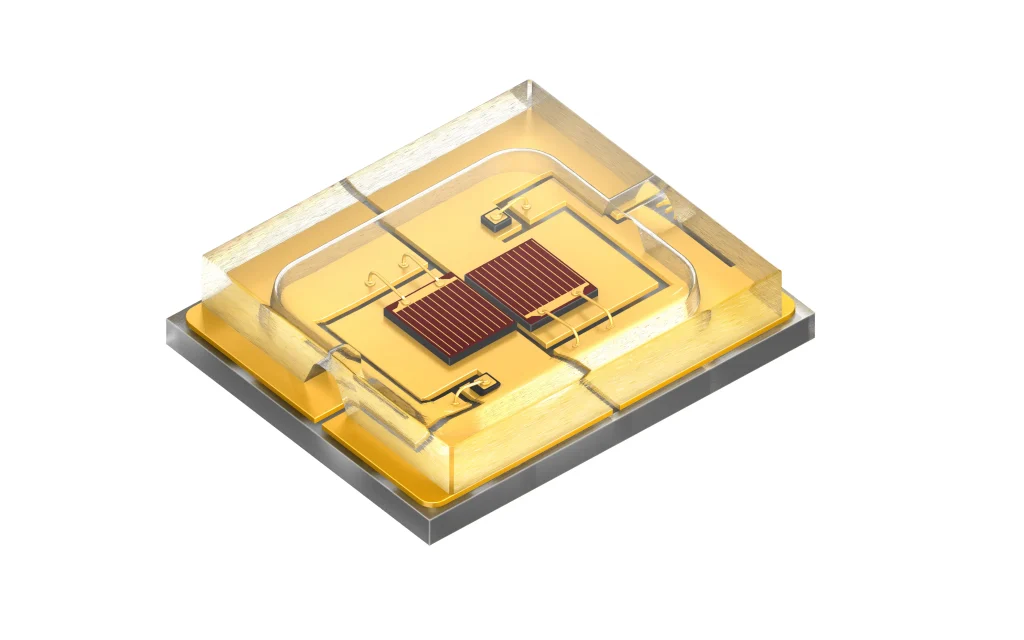
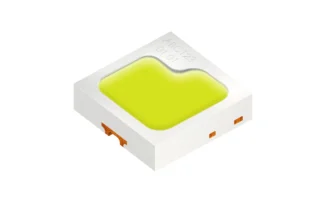
The OSTAR Projection LE A Q7WN was developed specifically for automotive head-up display applications using a DMD. (Image: ams OSRAM)
High light output also means high power dissipation. How do you handle thermal management?
Thermal design is an essential component of LED development. Our LEDs are integrated into a thermally optimized ceramic housing that significantly reduces thermal resistance between the chip and the heat sink. This allows the high light output to be maintained over the long term without causing thermal runaway or premature aging. At the same time, the ceramic housing is SMT-compatible, thereby supporting cost-effective mass production. For automotive applications, this means more stable output power across the entire temperature range, a longer service life, and lower maintenance and replacement costs.
Are AR HUDs technically ready for mass production today, or are we still in a transitional phase?
I would say we are at a turning point. The technology has largely made the transition from pilot projects to scalable production solutions. In addition to LEDs, we now also offer optics and driver reference designs specifically for automotive projection systems. This makes it significantly easier for OEMs and Tier 1 suppliers to develop complete HUD platforms. At the same time, integration remains challenging. Optics, electronics, drivers, and sensor software must be developed in tandem and then thoroughly validated for functional safety and regulatory compliance.
The light source alone does not make a head-up display. Only close collaboration between LED manufacturers, optics developers, Tier 1 suppliers, and OEMs enables a perfectly coordinated overall system. We therefore work with leading automakers in various regions to specifically optimize AR HUDs for different vehicle platforms. Our goal is for augmented reality head-up displays to become standard not only in luxury vehicles but also in mid-range models in the future. Ultimately, it’s not about a single component, but about a display and information system that equally enhances safety, the driving experience, and intelligent driving.
Thank you very much for the interview!
(The interview was conducted by Klaus Oertel, editor-in-chief and publisher of AEEmobility)