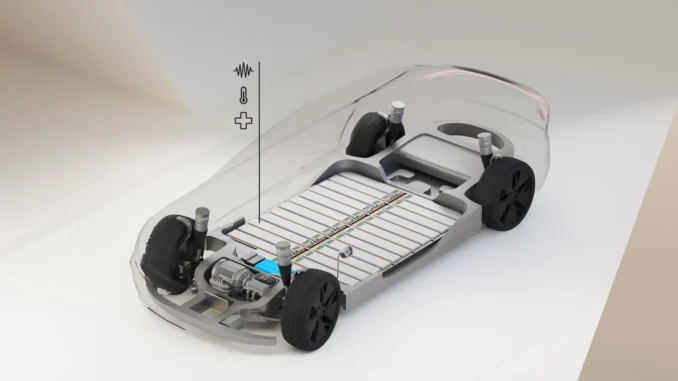
NXP Semiconductors launches the industry’s first battery management chipset (BMS) that integrates electrochemical impedance spectroscopy (EIS) directly into the hardware and synchronizes all components in the nanosecond range.
Unlike conventional software-based solutions, which often cannot detect rapid changes in the millisecond range, the hardware integration of EIS enables precise and rapid status analysis of each battery cell. This allows early signs of defects such as temperature deviations, aging effects, or micro-short circuits to be reliably detected—a decisive advantage for safe fast charging and longer battery life.
The new chipset consists of three components:
BMA7418 battery cell controller,
BMA6402 communication gateway
BMA8420 battery junction box controller
All three components include EIS functionality directly in the hardware. The system performs a discrete Fourier transform (DFT) at the chip level, delivering highly accurate impedance measurements in real time—without additional sensors or external modules.
How it works: An integrated signal generator sends controlled excitation signals through the battery. The cell responses are measured across different frequencies, revealing even the smallest changes inside the cell. In addition, the DC link capacitors in the system can be used as secondary energy storage devices, making the measurement process more efficient.
The solution is expected to be available from early 2026. The associated software is compatible with the NXP Automotive MCU S32K358. (oe)