Increasing system complexity, high safety requirements and the pressure to shorten development cycles characterize the everyday life of development teams. In this context, two technologies are becoming increasingly important: Rust as a programming language for safety-critical applications and virtual ECUs as a platform for accelerated development and validation.
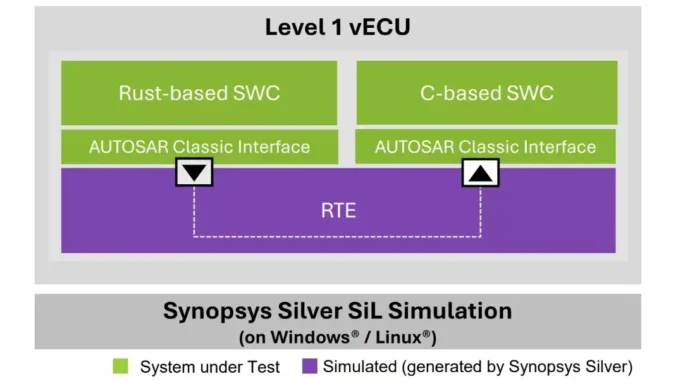
While the use of Rust in AUTOSAR Adaptive has already been specified, the integration of Rust-based software components (SWCs) into classic, C-based AUTOSAR stacks is now increasingly coming into focus. Synopsys is working with automotive software providers and early adopters to enable precisely this step. In a recent customer project, Synopsys demonstrated how the Synopsys Silver simulation solution was used to create a level 1 VECU with virtualized RTE. This environment enabled the seamless execution and validation of mixed C and Rust components on a single virtual ECU – including communication, runtime behavior and error simulation. The result: significantly accelerated development cycles, early error detection and measurably higher software quality. The particular advantage: thanks to its C compatibility, Rust can be gradually integrated into existing architectures without having to replace established modules such as RTE, BSW or MCAL. This hybrid approach makes it possible to develop new components in Rust in a safety-oriented manner, while continuing to use proven C-based infrastructure. This creates a pragmatic migration path for OEMs and suppliers who want to tap into Rust’s potential without a complete system changeover. (oe)